Best ServiceNow CMDB Alternatives in 2026: 10 Tools Evaluated on Discovery, Accuracy, and AI Readiness

ServiceNow CMDB alternatives are standalone configuration management platforms that deliver IT asset discovery, CI relationship mapping, and service dependency visualization without requiring full ServiceNow platform licensing. If you are building a shortlist in 2026, the real question is not just cost. It is whether the alternative gives your operations teams (and the AI agents now working alongside them) accurate, reconciled configuration data they can act on with confidence.
This guide evaluates 10 platforms on six criteria: discovery depth, hybrid coverage, ITSM integration breadth, data accuracy governance, service mapping capability, and AI readiness for 2026.
Key takeaways
- ServiceNow CMDB alternatives are standalone configuration management platforms that deliver discovery, CI relationship mapping, and service dependency visualization without full ServiceNow platform licensing.
- The CMDB and IT discovery software market is projected at $5.98 billion in 2026, growing at a 14.52% CAGR to reach $11.78 billion by 2031 (Mordor Intelligence).
- Discovery accuracy is the criterion that decides everything else. Configuration data that drifts out of date is a leading reason CMDB projects stall, regardless of platform.
- Most leading alternatives integrate two ways with ServiceNow, so they can enrich your existing ServiceNow CMDB rather than replace it.
- Agentic IT readiness is now a selection criterion: AI agents that act inside your environment need current, governed configuration data before they can act safely.
- Each tool below is scored on the same six criteria so you can build your own evaluation shortlist.
ServiceNow CMDB is the enterprise standard for configuration management. But for many teams, the mix of complex implementation, specialist administration, and platform-wide licensing makes it worth seeing what else is out there. Some want a standalone CMDB that feeds ServiceNow rather than replacing it. Others are moving off the platform entirely. And a growing number are re-evaluating their configuration layer specifically to support AI agents that need accurate data before they take action.
According to EMA Research, CMDB maturity tracks closely with ServiceOps outcomes: teams with more accurate CMDBs resolve incidents faster, execute changes with less risk, and trust their AI-assisted workflows more. That makes this a more consequential decision than a routine tooling swap.
This guide is written for IT Directors, IT Managers, Directors of IT Operations, and the compliance leaders who share accountability for configuration accuracy. Each tool is scored on the six criteria that matter once the environment is real.
Why Teams Evaluate ServiceNow CMDB Alternatives in 2026
ServiceNow CMDB implementations stall more often from data drift than from licensing cost. Without high-frequency discovery cycles feeding the CMDB on a recurring schedule, configuration items go out of date as servers are decommissioned, cloud instances spin up, and software is patched. EMA Research points to CMDB accuracy as a leading factor in ServiceOps maturity. Most teams looking at alternatives are after discovery-driven architectures that reduce manual CI upkeep and keep configuration data current with less hands-on effort.
The most common reasons IT leaders look beyond ServiceNow CMDB:
- Implementation complexity. Full ServiceNow Discovery requires extensive configuration, ongoing specialist administration, and platform-wide licensing. Many teams never reach the accuracy level set out in the original business case.
- Data drift. Without a recurring discovery engine behind it, CI records lose reliability quickly. When CIs are updated by hand (or not at all), the result is records that create change risk.
- Cost at scale. Mid-size organizations often face a five-figure annual licensing investment for ServiceNow CMDB, with implementation and administration adding meaningfully to the total. Standalone alternatives can deliver comparable accuracy at a lower overall cost.
- ITSM flexibility. Teams standardized on Jira, Ivanti, Halo, or other platforms want a CMDB that works with their chosen tool rather than one tied to a single ecosystem.
- Agentic IT readiness. AI agents handling incident triage, change analysis, and remediation need current, governed configuration data before they act. A CMDB last refreshed three weeks ago makes AI automation risky, not safe.
What Is a ServiceNow CMDB Alternative?
ServiceNow CMDB is a module inside the ServiceNow platform. It needs ServiceNow licensing and lives within the broader ServiceNow ITSM and ITOM ecosystem. A ServiceNow CMDB alternative is a standalone configuration management database that can integrate with any ITSM platform, ServiceNow included.
Standalone CMDB tools tend to offer three structural advantages over the ServiceNow CMDB module:
- Discovery focus. Dedicated CMDB platforms typically invest more in discovery breadth (agentless scanning, cloud asset APIs, hypervisor coverage, network device fingerprinting). The defensible benefit against a native module is fewer duplicates, less noise, and lower complexity, not a claim that they see assets ServiceNow cannot.
- Lower total cost of ownership. Standalone tools usually price on device or resource count rather than per-user or module-based licensing, which can escalate as you scale.
- Platform flexibility. Because they are not tied to one ecosystem, standalone CMDBs can feed CI and relationship data into Jira, Ivanti, Halo, Xurrent, or ServiceNow through two-way integrations.
It helps to separate CMDB platforms from IT service desk tools. Several products offer a CMDB module inside a broader ITSM suite (Freshservice, ManageEngine, HaloITSM, Jira). They are included here, but their CMDB capabilities are usually less mature than those of discovery-first platforms (Virima, Device42, Lansweeper, Faddom). That distinction matters when you build your evaluation criteria.
How to Evaluate ServiceNow CMDB Alternatives: Six Criteria That Matter
Here is the framework applied to all 10 tools, and one you can reuse internally.
- Discovery depth. Does the platform discover assets natively across cloud and on-premises, or does it lean on imports and manual entry? Look for agentless scanning, cloud asset APIs (AWS, Azure, GCP), hypervisor coverage (VMware, Hyper-V), network device discovery, and software inventory. A CMDB that cannot discover your environment on a recurring schedule will drift.
- Hybrid coverage. Does the tool treat cloud and on-premises as first-class, or is one bolted on? Most 2026 enterprise environments are hybrid. Check for a unified, normalized model across both.
- ITSM integration breadth. How many ITSM platforms does it integrate with, and how deeply? Two-way integrations (pushing CI data out, pulling ticket context back) beat one-way exports. If you keep ServiceNow as the ITSM but want a better CMDB layer, two-way sync is the requirement.
- Data accuracy governance. How does the tool resolve conflicts between discovery sources? Multi-source reconciliation (merging agent, agentless, and cloud-API data into one authoritative record) is what separates an accurate CMDB from an expensive spreadsheet. Ask every vendor how their platform resolves a conflict when two sources report different values for the same CI.
- Service mapping capability. Can the tool map which infrastructure supports which business services? Service mapping is needed for change impact analysis and incident impact assessment. It is present in discovery-first tools like Virima (ViVID), Device42, and BMC Helix, and limited in ITSM-first tools like HaloITSM.
- AI readiness (2026 addition). Can the CMDB serve AI agents with current, governed data? Agents handling L1 triage, change analysis, or remediation need accurate, query-able configuration data before they act. Tools with drifting data, manual update cycles, or no query API become a liability in an agentic environment.
Comparison Table: 10 ServiceNow CMDB Alternatives
Use this as a starting shortlist; each tool is detailed below.
| Tool | Best for | Discovery type | ITSM integrations | AI readiness |
|---|---|---|---|---|
| Virima | Mid-to-large, hybrid IT | Agentless + agent | ServiceNow, Jira, Ivanti, Halo, Xurrent | High (ViVID + runtime truth) |
| Device42 | Data-center-heavy infra discovery | Agentless + agent | ServiceNow, Jira, Freshservice | High |
| Faddom | App dependency mapping | Agentless (passive) | Via API/integrations | Moderate |
| Lansweeper | Pure discovery / visibility layer | Agentless | ServiceNow, Jira, Freshservice | Moderate |
| BMC Helix | Large enterprise, mature ITIL | Agent + agentless | BMC ecosystem, two-way | High |
| Ivanti Neurons | Enterprise automation + CMDB | Agentless + agent | Full ITSM suite | High |
| ManageEngine SDP | Mid-market, budget-conscious | Agent + agentless | Built-in ITSM + 3rd party | Moderate |
| Freshservice | SMB to mid-market, fast adoption | Agent + agentless | Built-in ITSM + Jira + Slack | Moderate |
| Jira SM Assets | DevOps / Atlassian-standardized | Via connectors | Jira ecosystem | Moderate |
| HaloITSM | Mid-market ITSM + basic CMDB | Agent-based | HaloITSM native | Low-Moderate |
Pricing estimates reflect publicly available information as of June 2026 and vary by asset count, deployment model, and contract term. Confirm current pricing directly with each vendor.
The 10 Best ServiceNow CMDB Alternatives in 2026
1. Virima CMDB
Trusted runtime truth for agentic IT, grounded in discovery across hybrid environments.
Best for: Mid-to-large enterprises running hybrid IT with complex service dependencies, active CMDB drift, and plans for AI-assisted operations.
Not ideal if: You want a ticketing-first service desk with light asset tracking. Virima is CMDB, discovery, and service mapping, not a full ITSM replacement.
Key CMDB capabilities
- Agentless and agent-based discovery across on-premises, cloud (AWS and Azure), virtual (VMware, Hyper-V), and network infrastructure
- Multi-source reconciliation that merges CI data from several discovery sources into one authoritative record and resolves conflicts
- CMDB health scoring that tracks accuracy, completeness, and freshness so teams see where data needs attention
- CI lifecycle management from deployment through decommission, surfacing EOL and EOS risks
- Change impact analysis that shows downstream CI impact before a change is approved
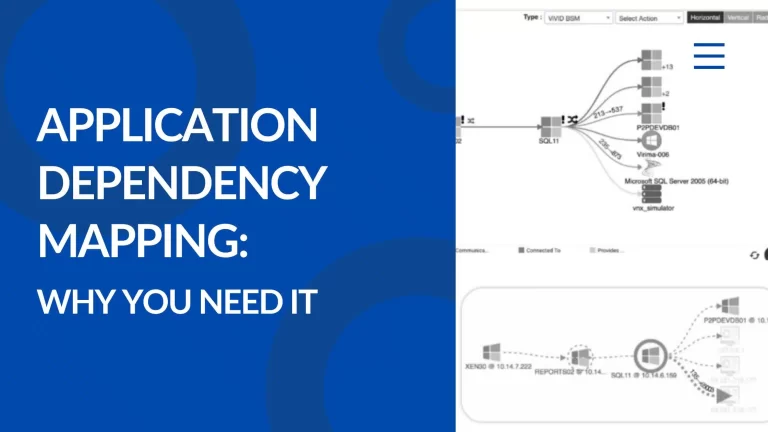
- ViVID Service Mapping, which builds dynamic application-to-infrastructure dependency maps from discovery data once service definitions are provided (via spreadsheet import or integrations such as LeanIX), giving you impact context before changes and faster root-cause work during incidents
- Two-way ITSM integrations with ServiceNow, Jira/Atlassian, Ivanti, Halo, and Xurrent: pushes discovered CIs and relationships out, pulls ticket context back in
- Alert and incident correlation that links alerts to CIs and affected services
- First dependency map delivered in under 60 minutes from initial deployment
Pricing: Contact Virima; pricing is based on asset count and deployment scope. Free trial and proof-of-concept engagements available. See pricing plans.
How it differs from ServiceNow CMDB: Virima’s differentiation is trusted runtime truth grounded in discovery: a CMDB populated by authoritative multi-source discovery rather than manual curation. ViVID maps are built from that discovery data, giving impact context that ServiceNow CMDB approximates only with separate Service Mapping licensing. Virima also integrates with ServiceNow both ways, so it suits teams extending the ServiceNow ecosystem (fewer duplicates, less noise, lower cost) rather than replacing it.
Quick answer – What makes Virima different from ServiceNow CMDB?
Virima delivers trusted runtime truth: a CMDB populated by agentless discovery across on-premises, cloud, and hybrid environments, reconciled from multiple sources and enriched with dependency maps via ViVID. Where ServiceNow CMDB leans on manual CI curation and specialist administration, Virima builds its first dependency map within 60 minutes of deployment and integrates two ways with ITSM platforms including ServiceNow, Jira, Ivanti, Halo, and Xurrent, so teams can get a better CMDB layer without migrating their full ITSM platform.
2. Device42
Discovery-first CMDB with deep dependency visualization for infrastructure-heavy environments.
Best for: Complex on-premises or data-center-heavy infrastructure needing precise discovery and dependency mapping, independent of ITSM choice.
Not ideal if: You want tight native integration with one ITSM platform or a unified service-management experience. Device42 is discovery-focused, not an ITSM itself.
Key CMDB capabilities
- Discovery across physical, virtual, cloud, and network infrastructure
- Dependency mapping across applications, servers, databases, and network components
- Hybrid cloud tracking in a unified model
- API-based integrations with ServiceNow, Jira Service Management, Freshservice, and others
- Change impact analysis showing affected services before a change
- Mobile access, customizable dashboards, RBAC, audit trails, encryption
Pricing: Starts around $3,500/year for smaller deployments; mid-size (500 devices) often $5,000-$8,000/year. 30-day free trial; pricing scales with device count.
How it differs from ServiceNow CMDB: Device42 competes on discovery depth and dependency mapping rather than ITSM workflow breadth. Many teams run it as the discovery engine feeding ServiceNow CMDB. Virima’s edge is native ViVID service mapping and broader ITSM integration; Device42’s service visualization is strong but needs more configuration for non-infrastructure dependency maps.
3. Faddom
Passive agentless application dependency mapping with minimal deployment overhead.
Best for: Fast, non-invasive application dependency mapping for migration planning, DR preparation, or hybrid cloud visibility. Faddom deploys in under an hour without touching production.
Not ideal if: You need a full CMDB with ITSM workflow integration, compliance governance, or end-to-end CI lifecycle management. Faddom is dependency-mapping-first.
Key CMDB capabilities
- Passive agentless discovery using network traffic analysis (not active scanning) to map application dependencies without impacting production
- Continuously updated dependency maps
- Fast deployment, with maps typically available within 60 minutes
- Hybrid and multi-cloud coverage (on-premises, AWS, Azure, GCP)
- ITSM integration via API; change impact analysis and migration planning support
Pricing: Contact Faddom; usage-based model with a free trial.
How it differs from ServiceNow CMDB: Faddom’s advantage is deployment speed and non-invasive discovery (no agents, no network reconfiguration). Its limit relative to ServiceNow or Virima is governance depth: it provides maps but not full CI lifecycle management, compliance reporting, or an ITSM integration framework. It works best as a discovery layer feeding a more capable CMDB.
4. Lansweeper
Agentless IT asset discovery at scale, the visibility layer for hybrid environments.
Best for: Comprehensive, accurate asset visibility as a CMDB foundation. Lansweeper is the discovery engine many ITSM and CMDB platforms integrate with to improve CI accuracy.
Not ideal if: You need full CMDB service mapping, ITSM workflow integration, or CI relationship modeling. Lansweeper enriches CMDBs rather than functioning as one on its own.
Key CMDB capabilities
- Agentless discovery across Windows, Mac, Linux, network devices, printers, cloud assets, and IoT
- Recurring asset scanning that maintains current inventory
- Software inventory and license tracking; technology insights and risk reporting
- Integrations with ServiceNow, Jira Service Management, Freshservice, and asset management platforms
- AI-assisted asset classification (2026 addition)
Pricing: Usage-based, with a free tier for smaller environments; contact Lansweeper for enterprise pricing.
How it differs from ServiceNow CMDB: Lansweeper addresses the ServiceNow discovery gap directly; many teams run it as the discovery engine feeding CI data into ServiceNow CMDB. It improves the accuracy of whatever CMDB it feeds rather than replacing it. If stale CI data is your main issue and you want to keep ServiceNow, Lansweeper (or Virima, which also feeds ServiceNow two ways) beats a full migration.
5. BMC Helix CMDB
Mature enterprise CMDB with AI-assisted impact analysis and federated data integration.
Best for: Large enterprises with mature ITIL frameworks, complex service models, and existing BMC Helix investments needing advanced dependency modeling and multi-source federation.
Not ideal if: You need fast time to value, simple pricing, or lightweight deployment. BMC Helix is a strategic platform requiring structured planning. (See our BMC Helix CMDB alternatives guide.)
Key CMDB capabilities
- Agent-based and agentless discovery across hybrid environments
- Multi-cloud topology and service mapping
- AI-driven impact prediction (BMC HelixGPT, 2026 addition)
- Federation of multiple configuration data repositories
- Advanced business-service modeling; deep integration with the BMC Helix ITSM/ITOM suite
- Compliance and audit-readiness features
Pricing: Enterprise subscription, module-based; contact BMC. No published public pricing.
How it differs from ServiceNow CMDB: BMC Helix is the most direct enterprise-tier competitor to ServiceNow CMDB; both are ITIL-aligned with mature ecosystems. The deciding factor is usually ecosystem: if your stack is ServiceNow, moving to BMC means re-integrating your ITSM workflow. Standalone discovery-first tools (Virima, Device42) offer a lower-disruption path that layers onto either platform.
6. Ivanti Neurons
Discovery and service management for enterprises standardized on Ivanti.
Best for: Enterprises that want CMDB capabilities tightly coupled with ITSM automation, endpoint security, and AI-assisted incident workflows, especially those already running Ivanti ITSM.
Not ideal if: You are not standardized on Ivanti. Its CMDB strengths show up inside the Ivanti ecosystem; standalone use cases are better served by discovery-first tools.
Key CMDB capabilities
- Discovery across cloud assets and endpoint-heavy environments
- Service relationship modeling and dependency visualization
- AI-powered incident insights and proactive automation
- Endpoint visibility and security-posture integration; hybrid coverage; full ITSM integration within the Ivanti platform
Pricing: Enterprise pricing; contact Ivanti. No published public pricing.
How it differs from ServiceNow CMDB: Ivanti Neurons blends CMDB with endpoint management and security operations more tightly than others here. For Ivanti-standardized teams, it provides an integrated CMDB layer with no extra tooling. For ServiceNow, Jira, or multi-ITSM environments, it is harder to justify outside the Ivanti ecosystem.
7. ManageEngine ServiceDesk Plus
Affordable ITSM with integrated CMDB for mid-market IT teams.
Best for: Mid-to-large teams wanting a unified ITSM + CMDB platform at a more accessible price point than ServiceNow, and teams modernizing from basic help desks to ITIL-aligned service management.
Not ideal if: Your main challenge is CMDB accuracy across a complex hybrid environment with thousands of changing assets. Discovery depth and relationship modeling are less mature than discovery-first platforms at large scale.
Key CMDB capabilities
- CI tracking and lifecycle management within the ITSM framework
- Relationship mapping between assets and services
- Change impact analysis linked to change workflows
- Agent-based and agentless discovery integrations
- Incident, problem, and change management in one platform; on-premises and cloud deployment
Pricing: Starts around $945/year for smaller deployments; scales with technician count and modules. Perpetual and subscription options; 30-day free trial.
How it differs from ServiceNow CMDB: It is the closest match to ServiceNow’s ITSM breadth at a lower price point. The CMDB module is practical for structured CI management within a unified platform, but it does not match the discovery depth or service-mapping maturity of Virima, Device42, or BMC Helix for large or complex environments.
8. Freshservice CMDB
Cloud-native ITSM with integrated CMDB for growing teams that prize fast adoption.
Best for: SMB to mid-market organizations moving from informal asset tracking to structured configuration management, wanting fast deployment and a unified service desk + CMDB.
Not ideal if: You are a very large enterprise with complex topologies, multi-cloud estates, or advanced dependency modeling needs. Deep CI relationship modeling at scale is better served by discovery-first platforms.
Key CMDB capabilities
- Asset and CI lifecycle management with relationship tracking
- Discovery via agent and third-party integrations (including Device42)
- Workflow-driven CMDB updates; AI-powered insights via Freddy AI
- Integration with Jira, Slack, Microsoft Teams, and major cloud platforms
- SaaS deployment with a low training curve
Pricing: Tiered: Starter ~$19/agent/mo, Growth ~$49, Pro ~$89, Enterprise ~$109. 14-day free trial. Per-agent pricing compounds for large teams.
How it differs from ServiceNow CMDB: Freshservice is consistently among the easiest ServiceNow CMDB alternatives to adopt, and its module covers CI tracking, relationship mapping, and change impact well. The trade-off is discovery depth: native discovery is limited, so complex hybrid environments usually pair it with a dedicated discovery tool (Lansweeper or Virima) feeding CI data in.
9. Jira Service Management (Assets)
CMDB within the Atlassian ecosystem for DevOps-centric teams.
Best for: DevOps teams and Atlassian-standardized organizations that want asset and CI tracking inside their Jira incident and change workflows.
Not ideal if: You need native cloud discovery, multi-cloud inventory, or dependency mapping outside Atlassian. Jira Assets is ITSM-native CMDB; cloud discovery needs third-party connectors.
Key CMDB capabilities
- CI tracking with custom schema definition
- Integration with Jira incident and change workflows (ticket-to-asset linking)
- Service dependency insights within Jira; change traceability across dev and ops
- Flexible schema; integrations with Lansweeper, Oomnitza, and other discovery tools via connectors
Pricing: Free tier (up to 3 agents); Standard ~$21/agent/mo, Premium ~$47/agent/mo; Enterprise via Atlassian sales. 7-day free trial.
How it differs from ServiceNow CMDB: Jira Assets (formerly Insight) is the most compelling option for Atlassian-standardized teams whose incident and change workflows live in Jira. Its key limit for hybrid cloud is discovery: it does not natively call cloud provider APIs, relying on connectors and CSV imports. Large cloud estates usually need a dedicated discovery tool (Lansweeper, Virima) feeding CI data in for freshness.
10. HaloITSM
Scalable, user-friendly ITSM with a CMDB module for mid-market organizations.
Best for: Mid-market organizations wanting an approachable, affordable ITSM platform with built-in CMDB and both cloud and on-premises deployment.
Not ideal if: Your priority is deep discovery, advanced dependency mapping, or agentic IT readiness. HaloITSM’s CMDB is ITSM-adjacent; it tracks assets but is not a discovery-first platform.
Key CMDB capabilities
- CI tracking and asset relationship management within the ITSM context
- Intuitive interface with low training overhead
- On-premises and cloud deployment; integration with HaloITSM service desk, incident, and change workflows
- Scales from small teams to larger enterprises; cost-effective relative to ServiceNow licensing
Pricing: Contact HaloITSM; mid-market model with a free trial.
How it differs from ServiceNow CMDB: HaloITSM is primarily an ITSM platform with CMDB capabilities, not a dedicated CMDB or discovery platform. As a ServiceNow CMDB alternative it suits teams that need basic CI tracking inside their service desk workflow, not those whose main challenge is CMDB accuracy, hybrid discovery, or dependency visualization.
Quick Answers to Common CMDB Questions
What CMDB tools support agentless discovery?
Agentless CMDB discovery scans infrastructure without installing software agents, using network-level protocols (SNMP, WMI, SSH, REST APIs) to identify CIs and map dependencies. Platforms with native agentless discovery include Virima, Device42, Lansweeper, Faddom, BMC Helix Discovery, and Ivanti Neurons. Agentless coverage matters most in hybrid and cloud-heavy environments where deploying agents across thousands of short-lived workloads is impractical, and it is the main line between discovery-led CMDBs and inventory-first asset tools.
How big is the CMDB market in 2026?
The CMDB and IT discovery software market is projected at $5.98 billion in 2026, growing at a 14.52% CAGR to reach $11.78 billion by 2031, according to Mordor Intelligence. Two forces drive it: rising hybrid IT complexity that demands accurate configuration visibility, and the growth of agentic AI operations that need current, governed data before agents act.
What is the difference between CMDB and ITAM?
A CMDB maps relationships between configuration items (how servers, applications, network devices, and cloud instances connect and depend on each other). ITAM tracks asset ownership, lifecycle, cost, license compliance, and contracts. They share underlying asset data but serve different workflows, and most enterprise teams need both: CMDB for change impact and incident response, ITAM for financial governance and compliance. Discovery-led platforms like Virima bridge the two by maintaining CMDB accuracy while feeding ITAM lifecycle data from the same discovery source.
How to Choose the Right ServiceNow CMDB Alternative for Your Organization
Stay on ServiceNow CMDB and add a discovery layer (Lansweeper or Virima feeding two ways into ServiceNow) if:
- Your ITSM workflows are deeply invested in ServiceNow
- Your main challenge is CMDB accuracy and drift, not licensing cost
- You want better CI accuracy without a platform migration
Move to a discovery-first standalone CMDB (Virima, Device42, or BMC Helix) if:
- You run a hybrid environment with thousands of changing assets
- You need dependency mapping for change impact analysis
- You are preparing for AI-assisted operations and need current, governed data
- You want ITSM flexibility across Jira, Ivanti, Halo, or ServiceNow
Move to an ITSM-bundled CMDB (Freshservice, ManageEngine, HaloITSM, Jira SM) if:
- You want a unified service desk + CMDB at a lower price point
- Your environment is not deeply complex (under ~500 managed assets)
- Fast adoption and low training overhead are top priorities
- You do not have a dedicated CMDB administrator
If you want a deeper feature-by-feature breakdown, our guide to the best CMDB software in 2026 compares the same platforms on data quality and total cost.
Why IT Teams Choose Virima as a ServiceNow CMDB Alternative
Virima is built for teams that need trusted runtime truth across their environment: live, explainable configuration data covering what exists, how it is connected, what changed, what could break, and who owns it. That data serves both the people making decisions and the AI agents that need governed guardrails before they act.
Three things set Virima apart from the alternatives in this guide:
- Discovery authority. Virima populates your CMDB from authoritative multi-source discovery (agentless network scans, agent-based endpoint inventory, cloud asset APIs, and hypervisor integrations). Multi-source reconciliation resolves conflicts, so the CI record reflects what actually exists rather than the last thing someone typed.
- Dependency maps without the manual overhead. ViVID builds dynamic application-to-infrastructure dependency maps from discovery data once service definitions are provided. The maps update as infrastructure changes, giving accurate impact context for change management and faster root-cause work during incidents, without a dedicated mapping team.
- ITSM flexibility. Virima integrates two ways with ServiceNow, Jira, Ivanti, Halo, and Xurrent. Teams that want a better CMDB layer without changing their ITSM platform can run Virima alongside their existing tools, pushing accurate CI and relationship data out and pulling ticket context back in.
Ready to see Virima in your environment? We deliver a first dependency map in under 60 minutes. Schedule a demo.
Frequently Asked Questions
What is a ServiceNow CMDB alternative?
A ServiceNow CMDB alternative is a standalone configuration management database that delivers IT asset discovery, CI relationship mapping, and service dependency visualization without requiring full ServiceNow platform licensing. Many alternatives integrate directly with ServiceNow, supplementing or replacing only the CMDB module rather than the whole platform.
How much does ServiceNow CMDB cost?
ServiceNow CMDB licensing is part of the broader ServiceNow ITOM or ITSM platform. Mid-size organizations typically face a five-figure annual investment, with implementation and administration adding meaningfully on top. Contact ServiceNow directly for current pricing.
What is the most important criterion when evaluating CMDB alternatives?
Discovery accuracy. The most common reason CMDB projects stall is data drift, where CIs go out of date within weeks without recurring discovery feeding the database. Assess any alternative first on discovery depth, agentless coverage, and how it reconciles data from multiple sources.
Do ServiceNow CMDB alternatives integrate with ServiceNow itself?
Yes. Most leading alternatives offer two-way integration with ServiceNow. Tools such as Virima, Device42, and Lansweeper push discovered CI and relationship data into ServiceNow CMDB, enriching the record set without a full migration, which makes them viable for teams extending ServiceNow rather than replacing it.
What CMDB tools support agentless discovery?
Agentless CMDB discovery platforms include Virima, Device42, Lansweeper, Faddom, and BMC Helix Discovery. Agentless tools use network-level protocols (SNMP, WMI, SSH, REST APIs) to discover assets without installing software on target devices, which is important in hybrid and cloud-heavy environments where agent deployment across thousands of short-lived workloads is impractical.