Top 4 Benefits of Having a Truly Visual CMDB

Table of contents
The configuration data in your Configuration Management Database (CMDB) is some of the most complex data your company generates. With list after list of records and complex webs of dependencies, even technology experts have difficulty comprehending its complete scope and many nuances. Adding to the difficulty is the data that is continuously changing, as your IT environment evolves and its pace is rapidly accelerating. Modern infrastructure adds further complexity — Kubernetes CMDB coverage, for example, requires tracking containerized workloads across EKS, ECS, and AKS environments that shift constantly and rarely appear in static inventories. A visual CMDB helps solves these challenges. That foundation matters even more as AI automation expands — before deploying CMDB for agentic AI workflows, the quality and structure of your CMDB data directly determines whether those agents act on truth or error.
Why is visual CMDB important?
The systems this data represents are critical to your business operations and you can’t support them effectively if you don’t understand what you are working with.
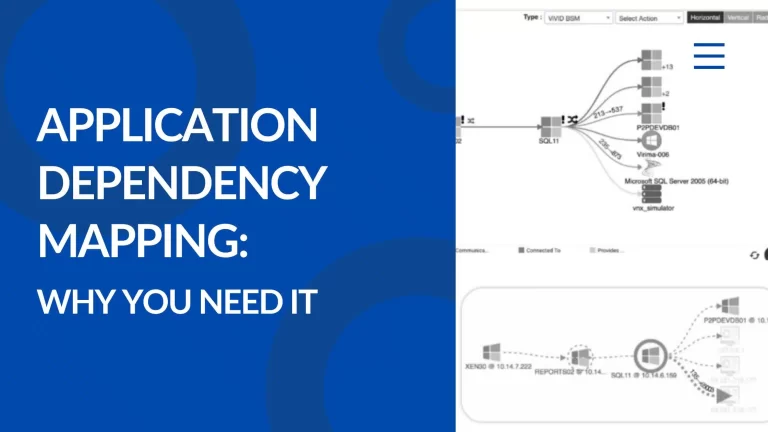
Humans Understand More If They Can Visualize It
As the saying goes – “A picture is worth a 1,000 words.” Whether it is exactly 1,000 or not, the concept is accurate. The human brain can understand much more data in visual form than as numbers and words. Not only are we able to understand the data, but also, we have the ability to:
– Understand context
– Identify relationships
– See patterns and trends
– Resolve gaps and redundancies
– Recognize changes
Nowhere is this more valuable than in understanding [database CMDB relationships](https://staging.virima.com/blog/oracle-mysql-database-cmdb-discovery) — Oracle and MySQL instances sit at the center of countless service dependencies, and visualizing those connections makes the difference between fast root-cause analysis and hours of guesswork.
Most Data Analysis Tools Aren’t Capable of Completing the Task
The starting point for any of this is CMDB accuracy — inaccurate configuration data doesn’t just limit what you can visualize; it actively misleads every decision made downstream. Unfortunately, most IT departments are trying to analyze and make decisions on their highly-complex configuration data using IT Service Management (ITSM) systems and other rudimentary tools that lack the power and precision to give them a true understanding of the complexities they must address. What makes most data analysis tools ineffective in this context is they don’t allow you to see insightful information, only the lists of data. This gap becomes especially critical when organizations begin using AI to act on CMDB data — CMDB AI governance requires more than storing configuration records; it demands verifiable, structured data that AI systems can safely interpret and act upon. This gap becomes especially critical when organizations begin using AI to act on CMDB data — CMDB AI governance requires more than storing configuration records; it demands verifiable, structured data that AI systems can safely interpret and act upon.
It Was First a Picture, It Can Be Again
A visual CMDB houses a digital representation of physical environments, tangible services and components with which people can touch and interact. Yet, we try to use rows and columns of data and basic analytical reporting tools. which are designed to summarize information to render that data into something useful – it isn’t working! This problem is especially visible in infrastructure-heavy environments where storage CMDB coverage is incomplete, leaving entire tiers of physical hardware invisible to the teams responsible for them.What IT teams actually need is the ability to transform the configuration data to a visual format, enabling them to see the objects in the context of the environment. This visual CMDB will allow them to use their natural cognitive abilities to interpret how components interact with each other and how the environment overall is changing. Sustaining that clarity over time depends on [CMDB accuracy](https://staging.virima.com/blog/cmdb-business-rules-automate-it-operations) — automated business rules that continuously validate and correct configuration records so the visual picture reflects reality, not a snapshot that drifts the moment something changes.
Using Our Brains for Which They Were Designed
Through visual CMDB, not only can we better understand our IT environments, but also develop that understanding with much less accurate and complete data than we would need for computer analysis. The human brain has a keen ability to play “connect-the-dots” and fill voids in the pictures we see. That ability is only as useful as the data feeding the picture — which is why [HCI CMDB visibility](https://staging.virima.com/blog/virima-storage-hci-topology-discovery) matters: hyper-converged infrastructure creates dense dependency layers that rarely surface in traditional inventory tools. Our brains are also skilled at resolving the overlaps of stereo images – filtering redundant information and creating compound images. These cognitive capabilities help us consume much larger and more complex data sets – just like the data we would find in a Configuration Management Database. Understanding [CMDB ROI](https://staging.virima.com/blog/cmdb-tco-analysis) means accounting for what poor data quality actually costs — in delayed decisions, failed changes, and the compounding overhead of maintaining inaccurate records. Understanding [CMDB ROI](https://staging.virima.com/blog/cmdb-tco-analysis) means accounting for what poor data quality actually costs — in delayed decisions, failed changes, and the compounding overhead of maintaining inaccurate records.
Virima is one of the industry leading platforms for capturing, managing, and visualizing data about your IT environment. Imagine the questions you could answer if you could visualize the data and dependencies stored in your Configuration Management Database and if you could trust the data to be accurate and current initially. A picture may be worth a 1000 words, but a picture of your visual CMDB data rendered with Virima is worth much more. For teams running ITSM on Xurrent, Xurrent CMDB gaps — missing CIs, stale relationships, undiscovered assets — are exactly what Virima’s automated discovery is built to close.
Learn more about these steps by watching our Webinar, 6 steps to CMDB Success.
Virima features can automatically discover and map your critical IT resources and the interconnections that link them to one another, your applications and services, and your users.
Virima is here to help. To get started, contact us today to schedule a demo and explore the possibilities!